


Kedarkantha Trek Overview
The Kedarkantha trek is a 5-day winter snow trek in Uttarakhand to the summit of Kedarkantha (3,810 m / 12,500 ft). It starts at Sankri village in Uttarkashi district and covers about 20 km on foot, through pine and oak forest, past the lake of Juda ka Talab and across open meadows. It is graded easy to moderate and suits first-time Himalayan trekkers.
The trail lies inside Govind Pashu Vihar National Park in the Tons River valley. Snow usually covers the route from December to April, which makes Kedarkantha one of the few Himalayan summits you can reach in winter. For deep snow, go between late December and February.
From the summit you get a 360° view of Swargarohini, Bandarpoonch, Black Peak (Kalanag) and Ranglana, with the Har Ki Dun valley below.
Our 5-day package runs from Dehradun to Dehradun for ₹5,999 per person, or ₹4,999 if you join at Sankri. It includes transport, a guesthouse stay in Sankri, tents and sleeping bags, vegetarian meals, forest permits for Indian nationals and a certified trek leader. You can reserve your seat with ₹2000.
Treks and Trails has run Kedarkantha batches since 2016 and has taken 5000 trekkers to the summit. Neil Bhuta, who leads our Uttarakhand batches, has summited Kedarkantha 40 times.
Kedarkantha Trek at a Glance
- Region: Uttarkashi district, Garhwal Himalaya, Uttarakhand
- Start / end: Dehradun (pickup at Prince Chowk, near Dehradun Railway Station) or Sankri
- Duration: 5 days, 4 nights
- Summit altitude: 3,810 m / 12,500 ft
- Base camp altitude: 3,430 m / 11,250 ft
- Trek distance: About 20 km over 4 trekking days
- Grade: Easy to moderate, suitable for beginners
- Best time: December to April (deep snow late December to February)
- Price: ₹5,999 from Dehradun · ₹4,999 from Sankri
- Group size: Maximum 30 trekkers
- Solo trekkers: Welcome. Tents are shared with trekkers of the same gender.
- Departures: Fixed departures every day of the season
Trek Highlights
On the trail
- Summit sunrise from 3,810 m, with views of Swargarohini, Bandarpoonch and Black Peak
- Camping beside Juda ka Talab, a high-altitude lake in an oak and pine forest
- Snow trekking through Govind Pashu Vihar National Park
Your batch
- Fixed departures every day. Pick any date in the season.
- Solo trekkers welcome. Join a batch on your own, and you'll share a tent with a trekker of the same gender.
- Small groups of up to 30 trekkers with a certified trek leader
- Mixed groups, typically 7:3 men to women
- 2 or 3 trekkers per tent, always the same gender
- Winter gear provided: microspikes and gaiters for the snow sections, plus tents, sleeping bags and mats
- Gear rental help at Sankri for jackets, trekking shoes and poles, if you don't own them
Kedarkantha Trek Cost 2026-27
The Kedarkantha trek costs ₹5,999 per person from Dehradun or ₹4,999 per person from Sankri, for 5 days and 4 nights. Both prices include meals, tents, a certified trek leader, forest permits for Indian nationals, microspikes and gaiters, and all taxes. You can reserve your seat with ₹2,000.
Dehradun to Dehradun: ₹5,999
- Pickup and drop at Prince Chowk, near Dehradun Railway Station
- Return transport between Dehradun and Sankri
- Guesthouse stay in Sankri on the first and last night
- Everything else in the trek package
Sankri to Sankri: ₹4,999
- For trekkers who reach Sankri on their own
- Includes the full trek package from Sankri and back
- Does not include transport between Dehradun and Sankri
How to book
- Pay ₹2,000 to reserve your seat.
- Pay the balance 7 days before your departure date.
- Fixed departures run every day of the season, so you can pick any date.
Optional extras
- Porter or mule for your personal backpack: ₹350 per bag per day (up to 12 kg)
- Foreign nationals: an extra ₹1,500 per person for forest entry fees
Kedarkantha Trek Itinerary at a Glance
Day 1: Dehradun to Sankri (1,967 m)
⏱ Bus pickup 6:30 AM at Prince Chowk, near Dehradun Railway Station.
About 200 km, an 8 to 9 hour drive via Mussoorie, Purola and Mori. Reach Sankri by evening, then a briefing and an overnight stay in the guesthouse.
Day 2: Sankri to Juda ka Talab (2,775 m)
Trek 4 km, 4 to 5 hours, climbing steadily through pine and oak forest.
Camp beside the Juda ka Talab lake, which is often frozen in winter.
Day 3: Juda ka Talab to Kedarkantha Base Camp (3,430 m)
Trek 3.5 km, 3 to 4 hours, through forest that opens into snow meadows.
A short day for acclimatisation, with a summit briefing in the evening.
Day 4: Base Camp to Kedarkantha Peak (3,810 m), descend to Hargaon Camp (2,713 m)
⏱ Summit push starts around 3:30 AM, so you reach the top for sunrise.
About 7 km, 7 to 8 hours in total. Microspikes and gaiters are provided for the snow, and you descend to camp at Hargaon.
Day 5: Hargaon Camp to Sankri to Dehradun
Trek 5 km, 2 to 3 hours, down to Sankri. ⏱ The bus leaves Sankri around 11 AM.
⏱ Drop at Prince Chowk, Dehradun, around 8 PM. Book onward trains or flights after 10 PM, or plan to stay overnight in Dehradun.

Kedarkantha Image


Kedarkantha Base Camp


Kedarkantha Winter

Kedarkantha Peak

Kedarkantha Adventure

Kedarkantha

Kedarkantha Houses

Kedarkantha Camping Photo

Trek to Kedarkantha

Kedarkantha Trek Photo

Kedarkantha Trekking

Kedarkantha Photo

Kedarkantha Trek Enjoyment

Kedarkantha

Keadrkantha Trek

Kedarkantha Weather

Kedarnatha Uttarakhand
Day 1Day 1: Dehradun to Sankri
Dehradun+
Day 1: Dehradun to Sankri
- Drive: 8 to 9 hours, about 239 km
- Sankri altitude: 1,967 m / 6,455 ft
- Stay: Guesthouse in Sankri
- Meals: Dinner
Pickup is at 7 am from Prince Chowk, near Dehradun Railway Station. The road runs through Mussoorie, Purola and Mori, then follows the Tons River valley to Sankri. You reach Sankri by evening and meet your trek leader for a briefing on the days ahead. If you booked the Sankri package, report at the guesthouse by 6 pm.
Day 2Day 2: Sankri to Juda ka Talab
Sankri+
Day 2: Sankri to Juda ka Talab
- Trek: 4 km, 4 to 5 hours
- Altitude: 1,967 m to 2,775 m (6,455 ft to 9,100 ft)
- Stay: Tents at Juda ka Talab
- Meals: Breakfast, lunch, dinner
This is the steepest climb of the trek, gaining about 800 m. The trail leaves Sankri through village fields, then climbs steadily through pine and oak forest, crossing small streams. You camp beside Juda ka Talab, a lake that often freezes over from late December to February.
Day 3Day 3: Juda ka Talab to Kedarkantha Base Camp
Juda Ka Talab+
Day 3: Juda ka Talab to Kedarkantha Base Camp
- Trek: 2.5 km, 3 to 4 hours
- Altitude: 2,775 m to 3,430 m (9,100 ft to 11,250 ft)
- Stay: Tents at Kedarkantha base camp
- Meals: Breakfast, lunch, dinner
A short day, so your body can adjust to the altitude. The forest thins into open meadows and shepherd huts, and the summit ridge comes into view. You reach base camp by early afternoon. Your trek leader checks everyone's fitness and oxygen levels before summit day.
Day 4Day 4: Base Camp to Kedarkantha Summit, Descend to Hargaon
Kedakantha Base Camp+
Day 4: Base Camp to Kedarkantha Summit, Descend to Hargaon
- Trek: About [X] km, 7 to 8 hours
- Altitude: 3,430 m to 3,810 m (11,250 ft to 12,500 ft), then down to Hargaon at 2713 m ( 8900 feet)
- Stay: Tents at Hargaon
- Meals: Breakfast, packed lunch, dinner
You start at 2 am to reach the summit for sunrise. The final climb is steep and usually under snow, which is where the microspikes and gaiters are needed. From the top you see Swargarohini, Bandarpoonch, Black Peak and the Kinner Kailash range, with the Har Ki Dun valley below. After the summit you descend to Hargaon, a wide meadow campsite.
Day 5Day 5: Hargaon to Sankri, Drive to Dehradun
Dehradun+
Day 5: Hargaon to Sankri, Drive to Dehradun
- Trek: 4 km, 2 to 3 hours
- Drive: 8 to 9 hours to Dehradun
- Meals: Breakfast
A gentle descent through forest brings you back to Sankri by late morning, and the drive to Dehradun starts from there. Expected drop at Prince Chowk is 7 pm. If you're travelling home the same night, book trains or flights after 8 pm, or plan to stay overnight in Dehradun.
What is included in the tour
What's Included in the Kedarkantha Trek Package
Transport
- Return transport from Dehradun to Sankri and back
- Pickup and drop at Prince Chowk, near Dehradun Railway Station
Stay
- 1 night in a guesthouse in Sankri, on 2 or 3 sharing
- 3 nights in tents on the trek, 2 or 3 trekkers per tent, always the same gender
- Couples get same tent
- Groups get same tent
Meals
- All vegetarian meals, from dinner on Day 1 to breakfast on Day 5
Team and safety
- Certified trek leader, local guide, cook and support staff
- First aid kit and oxygen cylinder on every batch
Gear
- Microspikes and gaiters for the snow sections
- Sleeping bags and mats, cleaned after every batch
- A-shaped or dome tents
- Kitchen, dining and toilet tents, with portable toilet seats
Permits and porterage
- Forest entry fees for Indian nationals
- Porters and mules to carry all camping equipment (not personal bags)
Taxes
- All Applicable taxes
What is NOT included in the tour
- Travel to and from Dehradun: your journey from your home city to Dehradun and back
- Meals during the drive: meals before reaching Sankri on Day 1 and after leaving Sankri on Day 5
- Accommodation in Dehradun: before or after the trek
- Personal backpack offloading: a porter or mule to carry your bag costs ₹350 per bag per day (up to 12 kg), arranged on request
- Personal gear and clothing: including any jackets, shoes or poles rented at Sankri (microspikes and gaiters are provided)
- Insurance: travel or personal insurance of any kind
- Personal expenses: bottled water, soft drinks, snacks, laundry, phone calls and personal medicines
- Tips for the trek staff: optional, but appreciated
- Forest entry fees for foreign nationals: an extra ₹1,500 per person
- Costs from events outside our control: bad weather, landslides, roadblocks, illness, government restrictions or emergency evacuation, including any extra days or itinerary changes these cause
- Anything not listed under "What's included"
Things to Carry for the Kedarkantha Trek
Temperatures on the trek drop below freezing at night in winter, so pack in layers. You can rent jackets, trekking shoes and poles at Sankri if you don't own them.
We provide (no need to bring): microspikes, gaiters, tents, sleeping bags and mats.
Bags
- Backpack, 50 to 60 litres, with a rain cover
- Small day pack, 20 litres, for summit day
Clothing (wear in layers)
- Thermal innerwear, top and bottom (1 set)
- Quick-dry full-sleeve T-shirts (2 or 3)
- Trekking pants (2). No jeans or cotton.
- Fleece jacket (1)
- Down or heavy padded jacket (1), for the summit and nights
- Waterproof jacket or poncho (1), for snow and rain
- Woollen sweater (1), optional for evenings
Head, hands and feet
- Woollen cap and a sun cap
- Neck warmer or buff
- Gloves (2 pairs): 1 fleece and 1 waterproof
- Trekking socks (3 pairs) and woollen socks for the night (1 pair)
- High-ankle trekking shoes with good grip, worn in before the trek. Sports shoes and casual boots are not suitable for snow.
- Trekking pole (1)
Sun protection
- Sunglasses with UV protection. Snow glare is strong.
- Sunscreen (SPF 50), lip balm and moisturiser
Water and lighting
- Water bottles (2 × 1 litre), at least one insulated so it doesn't freeze
- ORS or electrolyte sachets
- Headlamp or torch with spare batteries, for the early summit start
Toiletries
- Toothbrush and toothpaste
- Quick-dry towel
- Toilet paper and wet wipes
- Hand sanitiser
- Antifungal or antibacterial powder
- Plastic or zip bags for wet clothes and rubbish. Please carry all your waste back down.
Documents
- Original photo ID (Aadhaar, passport or driving licence)
- Booking confirmation
- Emergency contact details
Personal Medical Kit
Carry your own small kit, even though the trek leader has a first aid kit. Check with your doctor before taking any medicine, especially if you have a health condition.
- Paracetamol (e.g. Crocin), 1 strip: fever and body pain
- Aspirin (e.g. Disprin), 1 strip: headache
- Loperamide (e.g. Lomotil), 1 strip: loose motions
- Antacid (e.g. Digene), 1 strip: acidity
- Motion sickness tablets (e.g. Avomine or Vomistop): for the long mountain drive
- Diamox: for altitude sickness, only if your doctor advises it
- Band-aids (5), gauze and antiseptic liquid (e.g. Dettol)
- Antiseptic cream or powder (e.g. Betadine, Neosporin)
- Your regular prescription medicines, with enough for the full trip
Kedarkantha Trek FAQs
How high is Kedarkantha?
Kedarkantha summit is 3,810 m (12,500 ft) above sea level. The trek starts at Sankri village (1,967 m / 6,455 ft), and the highest campsite, Kedarkantha base camp, is at 3,430 m (11,250 ft). You gain about 1,850 m over three days before reaching the summit.
How long is the Kedarkantha trek?
The Kedarkantha trek covers about 20 km on foot over 4 trekking days, starting and ending at Sankri. Most days are 3.5 to 5 km. Summit day is the longest, at about 7 km. Including the drive from Dehradun and back, the full trip takes 5 days and 4 nights.
Is the Kedarkantha trek hard?
Kedarkantha is graded easy to moderate. The trail is well marked and the daily distances are short, but three things make it challenging:
- The steep climb on Day 2
- The early start and snow on summit day
- Below-freezing nights in winter
Fit trekkers find it comfortable. Without preparation, the summit push feels hard.
Can a beginner do the Kedarkantha trek?
Yes. Kedarkantha is one of the most popular first Himalayan treks in India. You don't need any trekking experience, but you do need basic fitness. Start training 4 to 6 weeks before the trek (see "How fit do I need to be?" below). A certified trek leader and microspikes for the snow sections are included in our package.
What is the cost of the Kedarkantha trek per person?
Our Kedarkantha trek costs ₹5,999 per person from Dehradun or ₹4,999 from Sankri, for 5 days and 4 nights. The price includes:
- Meals and tents
- A certified trek leader
- Microspikes and gaiters
- Forest permits for Indian nationals
- All taxes
You can reserve your seat with ₹2,000.
What is the best time for the Kedarkantha trek?
The best time is December to April, when the trail is under snow. Here's what each part of the year is like:
- January and February: heaviest snowfall and the coldest nights. This is the classic Kedarkantha experience.
- December: snow builds through the month, and the trail is usually fully white by Christmas.
- March and April: snow stays on the upper trail and base camp, with milder days and fewer crowds.
- May and June: green meadows and pleasant weather, with no snow
- July to September: monsoon rain makes the trail slippery and the views poor. Not recommended.
- October and November: clear skies and sharp mountain views. Light snow is possible on the upper trail from November.
What is the temperature at Kedarkantha?
Based on five winters of weather data (2021–2026), average temperatures on the trek are:
December to February
- Daytime on the trail: about 0°C to 10°C, getting colder as you climb
- Nights at Juda ka Talab: about −5°C to −9°C
- Nights at base camp: about −12°C to −16°C, and down to −20°C in cold spells
- Summit before sunrise: about −15°C to −18°C, colder with wind chill
March and April
- Daytime on the trail: about 5°C to 15°C
- Nights at base camp: about −6°C to −10°C
October and November
- Daytime on the trail: about 7°C to 14°C
- Nights at base camp: about −4°C to −8°C
Figures are averages from ERA5 weather reanalysis data, adjusted for each campsite's altitude. Actual conditions vary day to day. Pack the layers listed under Things to Carry.
Can I do the Kedarkantha trek in 3 or 4 days?
The trek itself takes 4 days from Sankri. We don't recommend doing it faster. Gaining altitude too quickly raises the risk of altitude sickness, and the shorter days on our itinerary give your body time to adjust. If you're short on time, book the Sankri-to-Sankri package and travel to Sankri on your own.
How do I reach Sankri, the base of the Kedarkantha trek?
Dehradun is the gateway to Kedarkantha. It has a railway station, and the airport is at Jolly Grant, about 25 km from the city. Sankri is about 200 km from Dehradun, an 8 to 9 hour drive via Mussoorie, Purola and Mori. Our Dehradun package includes pickup at Prince Chowk, near Dehradun Railway Station. Direct trains and flights connect Dehradun with Delhi and Mumbai.
How fit do I need to be for the Kedarkantha trek?
You should be able to jog 4 km in about 25 minutes before the trek. Start training 4 to 6 weeks ahead:
- Cardio: walk or jog daily, building up from 2 km to 5 km
- Stairs or hills: climb 15 to 20 floors with a light backpack, 3 times a week
- Stretching: 10 minutes daily to keep your legs and back flexible
- Breathing exercises: improve lung capacity for the altitude
Is the Kedarkantha trek safe for women and solo trekkers?
Yes. Solo trekkers are welcome, and you'll share a tent only with a trekker of the same gender. Our groups are mixed, typically 7:3 men to women, with a maximum of 30 trekkers. A certified trek leader stays with the group throughout the trek.
How many people share a tent?
2 or 3 trekkers share each tent, always of the same gender. Tents are A-shaped or dome tents. Sleeping bags and mats are provided and cleaned after every batch.
What food is served on the trek?
All meals are vegetarian, from dinner on Day 1 to breakfast on Day 5. We serve breakfast, lunch, evening tea with snacks, and dinner every day. On summit day, lunch is packed. Vegetarian food is easier to digest at altitude.
Is there mobile network on the Kedarkantha trek?
Jio usually works few km before Sankri. BSNL signal is weak there, and Airtel and Vi users lose network after Purola. There's no network on the trail itself, although a weak Jio signal sometimes appears at the summit. The last ATM on the route is in Purola, so withdraw cash in Dehradun, Mussoorie or Purola. Share your trek dates with your family before you leave so they know you'll be out of contact.
What happens if there's a medical emergency?
Every batch carries a first aid kit and an oxygen cylinder. Here's how we handle problems:
- If a trekker shows signs of altitude sickness, they descend with a staff member right away. Going down is the most effective treatment.
- For serious cases, the trekker is brought down to Sankri by mule or stretcher, then driven to the Community Health Centre in Purola (about 3 hours by road) or on to Dehradun.
- Helicopter evacuation, when needed, is coordinated through the State Disaster Response Force (SDRF).
Can I drink alcohol or smoke on the trek?
No. Alcohol dehydrates you and slows how well your body adjusts to altitude. Smoking reduces the oxygen your blood carries. Both raise the risk of acute mountain sickness, so they aren't allowed on our treks.
Do I need a permit for the Kedarkantha trek?
Yes. Kedarkantha is inside Govind Pashu Vihar National Park, and every trekker needs a forest permit. We arrange permits for everyone in the group. Fees for Indian nationals are included in the price. Foreign nationals pay ₹1,500 extra. Carry original photo ID, as the forest office checks it.
Who leads the trek?
Each batch is led by a certified trek leader, supported by local guides, cooks and porters from the Sankri area who know the trail in every season.
Are Kedarkantha and Kedarnath the same?
No. They are different places:
- Kedarkantha is a summit trek in Uttarkashi district, starting from Sankri village.
- Kedarnath is a temple and pilgrimage site in Rudraprayag district, reached by a trek of about 16 km from Gaurikund.
The names are similar, but the two are in different districts and are reached by different routes.
Kedarkantha, Brahmatal or Kuari Pass: which is better?
All three are good beginner winter treks in Uttarakhand:
- Kedarkantha is the best choice if you want to stand on a summit. It's also the easiest to reach, from Dehradun.
- Brahmatal has frozen lakes and close views of Trishul and Nanda Ghunti.
- Kuari Pass has views of Nanda Devi and is quieter than Kedarkantha in peak season.
For a first snow trek with a summit, choose Kedarkantha.
What is the legend of Kedarkantha?
Local legend says Lord Shiva came to Kedarkantha to meditate, but was disturbed by cattle grazing below and moved on to Kedarnath. Another story holds that the peak is named after Shiva's throat ("kantha"). A small shrine with a trident stands at the summit. Juda ka Talab is said to have formed when Shiva let water fall from his hair bun ("juda"), which gives the lake its name.
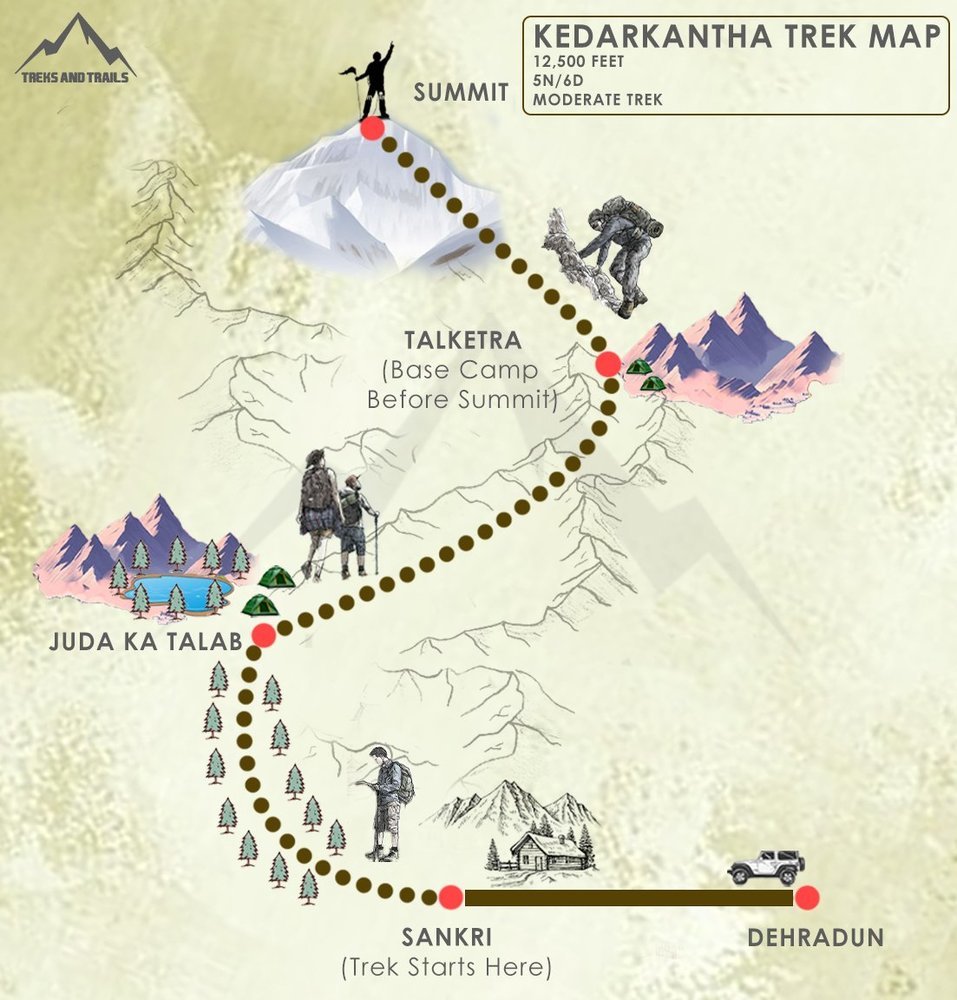
Kedarkantha Trek Route Map
The map shows the trail from Sankri to Juda ka Talab, Kedarkantha base camp and the summit, then down to Hargaon and back to Sankri, with the altitude of each campsite.
Similar Winter Treks
- Brahmatal Trek: frozen lakes and views of Trishul
- Kuari Pass Trek: Nanda Devi views on a quieter trail
- Har Ki Dun Trek: a valley trek that also starts from Sankri
- Dayara Bugyal Trek: wide snow meadows above Uttarkashi
- Nag Tibba Trek: a weekend snow trek near Mussoorie


